
.png)

Negative prices at Easter: why does this episode reveal a turning point for renewable energy producers?
The Easter weekend 2026 made an impression on the electricity markets.
In the space of a few hours, prices fell to exceptionally low levels, reaching up to -109 €/MWh on the spot market, with more than 25 hours of negative prices over the period.
This type of episode, which might have seemed exceptional a few years ago, is now part of a much deeper dynamic. This is not a simple economic accident, but a reflection of an electrical system in full transformation, under the effect of the rise in power of renewable energies.
Behind these negative prices lies a simple reality: producing electricity is no longer enough. It is becoming essential to know when to produce, and especially when to adapt.
An Easter weekend under stress for the electrical system
Several factors came together during this extended weekend. Electricity consumption was down, as is often the case during public holidays. At the same time, the weather conditions were particularly favorable to solar production, with significant amounts of sunshine over a large part of the country. Wind energy, too, contributed to sustained production.
This imbalance between abundant supply and reduced demand led to a situation of overproduction, which the electrical system had to absorb in real time. The price signal then played its full adjustment role, sliding into negative territory to encourage certain actors to reduce their injection.
Throughout the weekend, the market was marked by high volatility, with an average price around 6.5 €/MWh and differences sometimes exceeding 150 €/MWh in a few hours, illustrating a system under tension.
According to the electric transport network (RTE), these episodes are becoming more frequent as the share of renewable energies increases in the electricity mix. The network must deal with production that is more variable, more concentrated over certain time slots, and less correlated to consumption.
Negative prices: a normal mechanism in a changing system
Negative prices may come as a surprise, but they are by no means an anomaly. On the contrary, they constitute an essential economic signal in a liberalized market.
When electricity is produced in excess, the price becomes negative to encourage producers to reduce their production and restore balance. This mechanism is at the heart of the functioning of the wholesale market, and it is becoming more and more visible in a system dominated by energies with very low marginal costs, such as solar and wind.
The Energy Regulatory Commission (CRE) has also integrated this reality into its recent thinking, by gradually adapting the regulatory framework in order to encourage better responsiveness of installations in the face of these market signals.
What is changing today is therefore not the existence of negative prices, but their frequency and intensity.
What this episode reveals for renewable energy producers
For a producer, an episode like that of Easter weekend is not trivial. It highlights a fundamental evolution of the profession.
Until recently, asset performance was based primarily on its ability to produce in a stable and predictable manner. Now, value is moving towards the ability to interact with the market, to understand its signals and to adapt its behavior accordingly.
A park that produces heavily at a time when prices are negative can see the value of its electricity drop sharply. Conversely, a producer who is able to anticipate these episodes and adjust his production can limit his losses, or even optimize his valuation strategy.
Concrete example
Take the example of a photovoltaic power plant producing at full power in the middle of the day. If this production occurs at a time when the market is saturated, it risks being valued at a very low or even negative price.
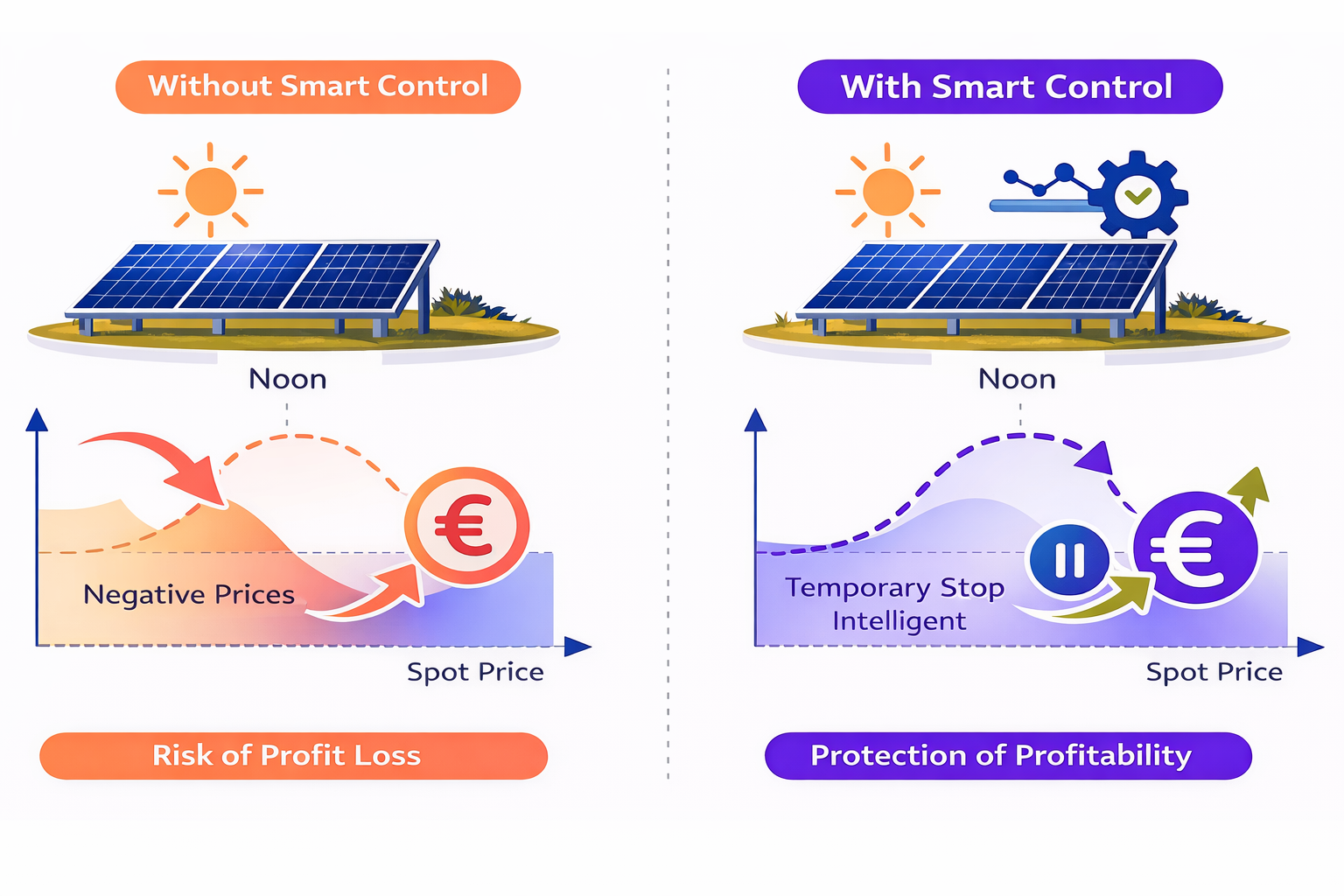
On the other hand, if this same power plant is managed in such a way as to temporarily reduce its injection during critical periods, it can maintain its profitability and resume production when market conditions become favorable again.
This arbitration, which once seemed marginal, is now becoming central.
Flexibility: a lever that has become essential
What this episode clearly highlights is the growing importance of flexibility in the electrical system.
Flexibility is the ability to quickly adapt its production or consumption according to the needs of the network. It makes it possible to smooth out imbalances, to limit extreme situations and to better valorize the electricity produced.
In a context where renewable energies play an increasingly important role, this ability to adapt is becoming a real driver of performance. It no longer concerns only major industrial players, but also energy producers, regardless of the size of their installations.
Market players are also increasingly insisting on this dimension in their speeches. All converge on the same idea: in the electrical system of tomorrow, the ability to be flexible will make the difference.
To learn more about these mechanisms, you can consult our article dedicated to the adjustment mechanism.
Towards a new role for aggregators in the electricity market
This evolution is also transforming the role of aggregators.
Historically, their mission consisted mainly of grouping production and marketing it on the markets. Today, their role is expanding considerably. They are becoming key players in valuation, able to anticipate market signals, manage assets and optimize strategies in real time.
In this context, the choice of its aggregator becomes a structuring element for the economic performance of a fleet. It is no longer simply a question of selling your electricity, but of valuing it intelligently, taking into account the increasing volatility of prices.
To understand the challenges related to the valorization of your production, you can also consult our dedicated offer concerning Remuneration supplement.
Bohr Energie's approach to these new challenges
Chez Bohr Energie, these developments are at the heart of our approach.
Rather than being subject to market fluctuations, we support producers in a logic of foresight and optimization. Thanks to detailed data analysis, forecasting tools and real-time asset management, we make it possible to adapt production to market conditions.
The aim is not only to avoid unfavorable situations, but also to take advantage of the opportunities offered by an increasingly dynamic system. In an environment where prices can vary greatly in a few hours, responsiveness is becoming a key performance factor.
In an environment where prices can vary by more than €100/MWh in a few hours, responsiveness becomes a key performance factor.
Conclusion: producing is no longer enough, you have to pilot
The Easter weekend 2026 is a perfect illustration of a transformation that is already under way: the transition from a system centered on production to a system centered on management.
In this new context, value is no longer limited to the electricity produced, but to how it is injected into the grid. Anticipating, adapting and managing are becoming essential skills for renewable energy producers.
What was once a constraint is gradually becoming an opportunity for those who know how to seize it.
Is your fleet ready to face these new market dynamics?
Negative price episodes will continue to increase.
Knowing how to anticipate and react to them is becoming a strategic challenge to secure your income.
Our teams support you to analyze your installation, identify optimization levers and implement a strategy adapted to your production profile.
Contact us to discuss it.