
.png)

The adjustment mechanism: a pillar of the balance of the electrical system
With the energy transition and the rapid development of renewable energies, the functioning of the electrical system is changing profoundly.
Electricity production is no longer based solely on large controllable power plants. It now comes from a set of more decentralized installations: hydroelectric power plants, wind farms, photovoltaic installations or biomass units.
In France, this transformation is particularly visible. According to the 2023 electric balance published by RTE, the installed capacity of renewable energies continues to increase strongly. For example, the French solar park has exceeded 19 GW in installed capacity, while wind power has reached nearly 22 GW.
In total, renewable energies now represent more than 40% of the production capacity installed in France, which is profoundly transforming the structure of the electrical network.
This evolution makes the electrical system more dynamic, but also more complex to balance. A fundamental principle must be respected: at all times, electricity production must be equal to consumption.
To maintain this balance in real time, the electricity transmission system operator (RTE), has several tools. Among them, the adjustment mechanism plays a central role.
But in concrete terms, how does this mechanism work and why has it become indispensable in the current electrical network? We explain to you.
Why network balance is an ongoing issue
The electrical system works continuously. Every second, the quantity of electricity produced must correspond exactly to the quantity of electricity consumed.
In France, electricity consumption can vary greatly during the day. During periods of high demand, consumption can exceed 80 GW, while it can fall below 30 GW during certain nights or weekends.
There are several situations that can cause an imbalance:
- Higher consumption than expected
- a sudden drop in power plant production
- meteorological variations affecting solar or wind production
- differences between production forecasts and actual production
When these discrepancies occur, the network manager must intervene quickly in order to avoid instability. The adjustment mechanism precisely makes it possible to mobilize production or consumption capacities capable of correcting these imbalances.
How the adjustment mechanism stabilizes the network
The adjustment mechanism is based on a simple principle: some market players offer capabilities that they can activate quickly if the network needs them.
These abilities can take many forms:
- increase electricity production
- reduce production
- temporarily reduce consumption
When the network operator identifies an imbalance, it activates the most suitable offers in order to restore the balance of the electrical system. The actors involved are then paid for the service provided to the network.
This mechanism is now one of the main levers for guaranteeing the stability of the electrical system.
Who can participate in the adjustment mechanism?
Today, the adjustment mechanism does not concern all actors in the same way. It is mainly aimed at actors capable of rapidly modulating their production or consumption.
Concretely, this concerns:
- electricity producers (hydraulic, thermal, wind, solar)
- manufacturers able to temporarily reduce their consumption (erasure)
- aggregators, which group together several installations to reach a critical size
However, to be activated by the network, an installation must meet technical and capacity criteria.
What is the minimum capacity to participate?
Direct access to the adjustment mechanism is generally reserved for assets of more than 10 MW in obligation to purchase (OA), or in Compensation supplement (CR).
This means that:
- a large power plant can participate alone
- but a smaller installation (for example a solar park of a few MW) cannot always participate directly
A mechanism that has become strategic with renewable energies
The development of renewable energies is profoundly transforming the electrical system.
Unlike traditional power plants, solar and wind generation is directly dependent on weather conditions. This variability makes the balance of the network more complex to maintain.
In this context, flexibility mechanisms such as the adjustment mechanism become essential for:
- absorb variations in production
- maintaining the stability of the network
- facilitate the integration of renewable energies
According to the electricity transmission network (RTE), the flexibility of the electrical system is one of the main challenges of the energy transition.
Concrete example: a power plant in the face of variations in production
Let's take the example of a photovoltaic park.
The electricity production of a photovoltaic park depends directly on sunlight. Even with efficient forecasting tools, there may be differences between planned and actual production.
An unexpected cloud, for example, can cause a drop in production of several tens of percent in a few minutes on a solar installation.
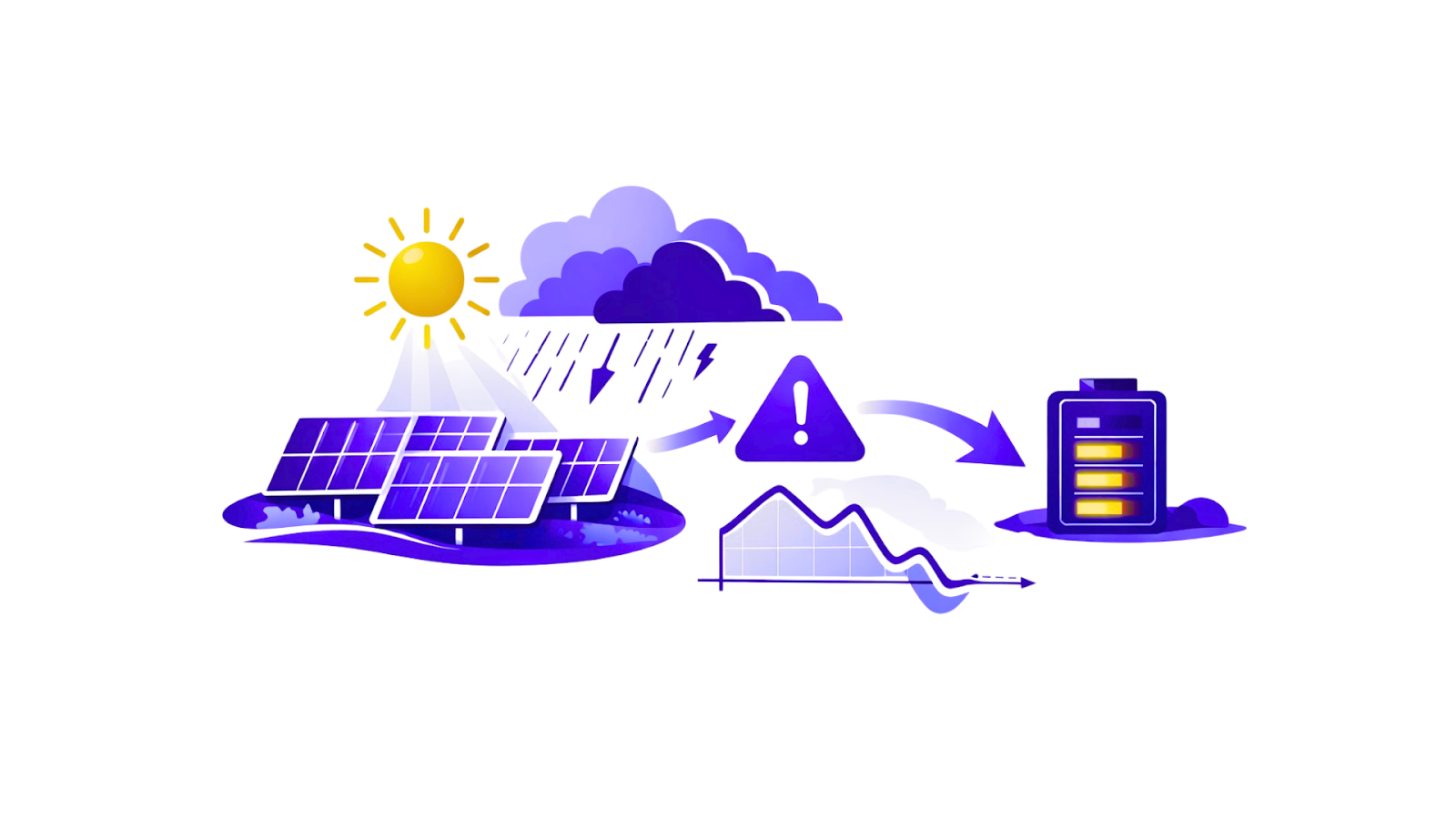
If this power plant operates alone, several difficulties may arise:
- the production injected into the network no longer corresponds to forecasts
- a balance gap is created on the electrical system
- this discrepancy may result in financial penalties for the producer
In these situations, the network manager (RTE) must rapidly mobilize other capacities available on the electrical system in order to compensate for this lack of production.
The adjustment mechanism makes it possible precisely to activate these abilities.
The role of aggregators in this new balance
In an increasingly decentralized electrical system, renewable energy aggregators play a key role.
Their mission is to group together several production facilities in order to optimize their participation in electricity markets and flexibility mechanisms.
By combining different energy active ingredients, it becomes possible to:
- sharing production variations
- propose network adjustment capabilities
- optimize the valorization of the electricity produced
- reduce exposure to risks associated with balance discrepancies
This approach allows producers to participate more effectively and easily in the mechanisms of the electricity market.
Supporting producers in an increasingly complex market
The evolution of the electrical system is accompanied by a complexity of market mechanisms and regulatory obligations.
In this context, renewable energy producers must face several challenges:
- follow the evolution of the electricity markets
- manage production forecasts
- master balancing mechanisms
- optimize the valorization of their energy
It is precisely to meet these challenges that specialized aggregators such as Bohr Energie support producers.
By combining several installations within the same portfolio, Bohr Energie makes it possible to optimize participation in electricity markets and flexibility mechanisms while securing the valorization of production.
Are you a renewable energy producer?
We support hydroelectric, solar and wind producers in optimizing and valorizing your energy on the electricity markets.
Do you want to study recovery solutions for your power plant?Contact us to discuss your project.